
Two peer-reviewed academic articles authored by members of the GAPs research team have been published in the CEEMR review
This week, two peer-reviewed academic articles authored by members of the GAPs research team have been published in the Central and Eastern European Migration Review (CEEMR), further strengthening the project’s scholarly outputs and international visibility.
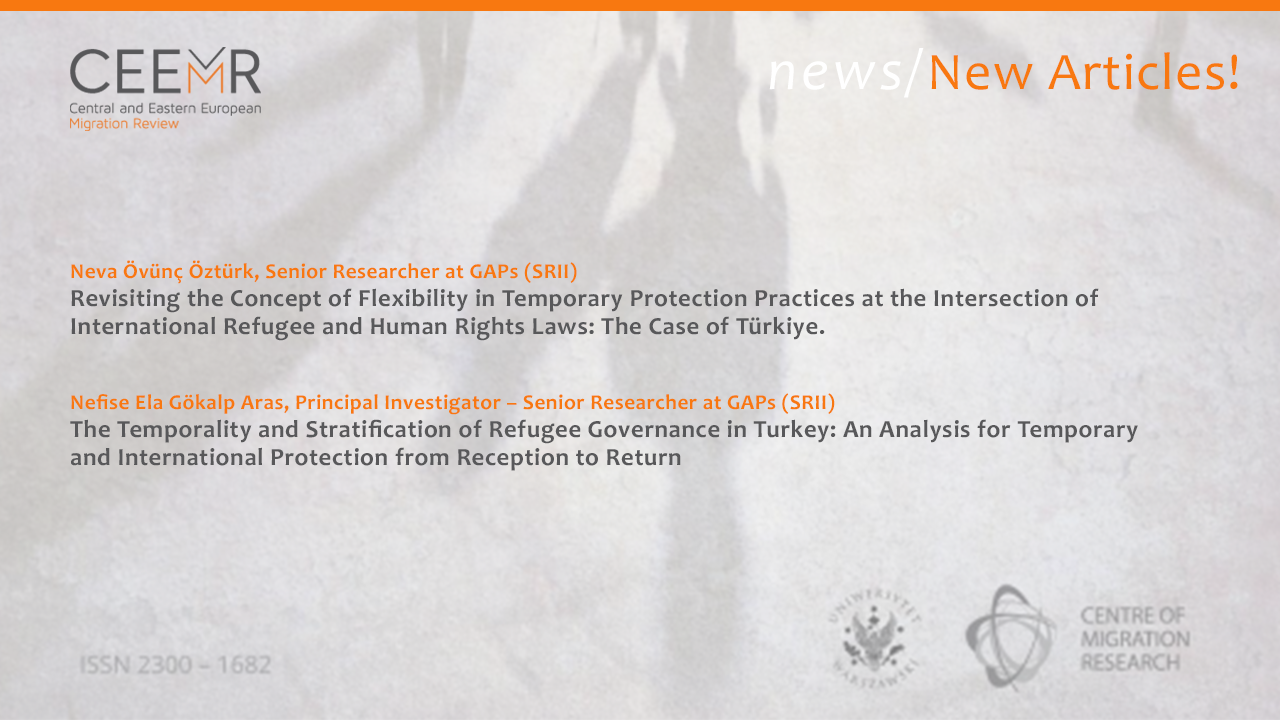
Neva Övünç Öztürk, Senior Researcher at GAPs (SRII), published the article “Revisiting the Concept of Flexibility in Temporary Protection Practices at the Intersection of International Refugee and Human Rights Laws: The Case of Türkiye.”
To access: Click here
The article critically examines the concept of “flexibility” in temporary protection regimes, focusing on both rule-making and implementation practices in Türkiye. It argues that while flexibility is often presented as a pragmatic response to mass displacement, excessive and unregulated discretion risks undermining legal certainty, the rule of law and fundamental rights. By situating the Turkish temporary protection regime within international refugee and human rights law, the study contributes to broader debates on responsibility-sharing and legal safeguards in international protection systems.
Nefise Ela Gökalp Aras, Principal Investigator – Senior Researcher at GAPs (SRII), published the article “The Temporality and Stratification of Refugee Governance in Turkey: An Analysis for Temporary and International Protection from Reception to Return.”
To access: Click here
This article analyses Türkiye’s refugee governance framework through the concepts of temporality and legal stratification, examining how different protection statuses structure refugees’ experiences from reception to return. Drawing on longitudinal research and multi-sited fieldwork, the study argues that temporality functions as a deliberate governance strategy rather than a purely administrative feature, while legal stratification institutionalises selective inclusion and sustained precarity. The article provides an in-depth analysis of how these mechanisms shape return policies and practices, particularly for Syrians under temporary protection.
Both publications directly align with the GAPs project’s core research objectives on international protection, migration governance and legal frameworks, and contribute to advancing evidence-based academic and policy discussions at the international level.