
GAPs Panel at the ESA RN35 Midterm Conference, Athens (27 November 2025)
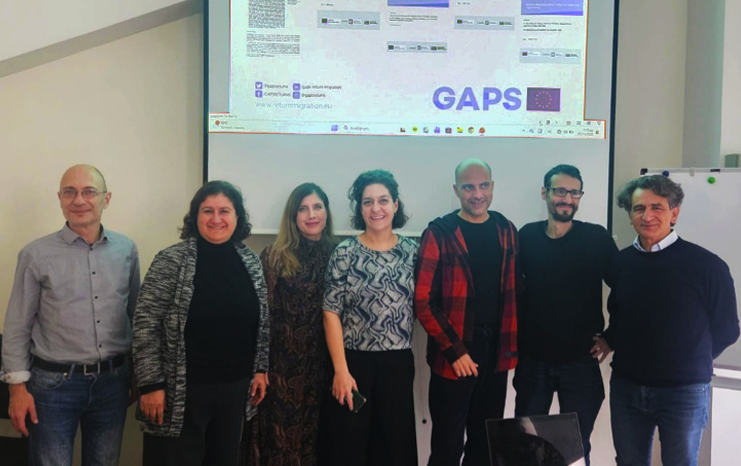
On 27-28 November 2025, the European Sociological Association (ESA) RN35 held the Sociology of Migration Midterm Conference in Athens, Greece, in collaboration with the National and Kapodistrian University of Athens. The Conference’s theme was Sociology of Migration after the 2015 ‘Migrant Crisis’, focusing on the impact of crises on migration and migration research.
The GAPs consortium member, the National Centre for Social Research (Εθνικό Κέντρο Κοινωνικών Ερευνών–ΕΚΚΕ), convened a dedicated panel (Return Migration Infrastructures: Actors, Activities and Technologies between Voluntariness and Enforcement) at the Conference to present cutting-edge findings from the GAPs Project. Chaired by the panel co-organisers Eva Papatzani and George Kandylis (EKKE), the discussant was Haris Tsavdaroglou (University of Amsterdam). The panel brought together GAPs researchers working across Europe and the Mediterranean to unpack the complexities of contemporary return migration infrastructures.
Eva Papatzani (EKKE) opened the session with an overview of the GAP’s Project, summarising its progress over nearly three years and presenting the main findings and conceptual directions emerging from the consortium’s comparative research, with a particular focus on the notion of Return Migration Infrastructures.
Panos Ηatziprokopiou (EKKE) presented the “Return Migration Infrastructures: Coercion, Informalities, and the Importance of Absent Practices: A Synthesis of Insights from GAPs Research”, which he co-authored along with George Kandylis, Eva Papatzani, Penny Koutrolikou (EKKE) and Joris Schapendonk (Radboud University). He highlighted that return migration infrastructure across the 11 GAP country cases operates through fragmented yet deeply interconnected procedures, shaped by a broad constellation of actors, uneven power relations, and pervasive informalities. Comparative findings reveal a shared continuum of coercion, from assisted return to forced removal and pushbacks, within which countries deploy similar infrastructural logics but differ in the intensity of enforcement, the centrality of security actors, and the extent of informal practices.
Soner Barthoma (Uppsala University) presented the co-authored paper with Zeynep Sahin Mencutek (BICC), titled “Diaspora Organisations and Refugee Migration Governance: Strategic Navigation Between State Institutionalisation and Community Loyalty.” Drawing on empirical research with diaspora associations, civil society networks, and refugee community actors, the paper examined how diaspora organisations operate within a challenging governance landscape marked by tightening state control and expanding migration management infrastructures.
George Kandylis (EKKE) presented the “Assisted Return Infrastructure between Voluntariness and Coercion: The Case of AVRR in Greece” paper, which he co-authored with Panos Hatziprokopiou, Eva Papatzani, Timokleia Psallidaki, Christina Varouxi and Katerina Vezyrgianni. He stated that return governance in Greece operates through three deeply interconnected infrastructures, in which formal procedures, security logics, and informal coercive practices coexist and often blur the line between “voluntary” and “forced.” Findings highlight that the particular case of AVRR in Greece is shaped by detention risks, unequal temporalities, and processes of irregularisation that undermine voluntariness.
The panel concluded with the presentation of the paper titled “Pushing Beyond the Borders: Unpacking Pushbacks and Pushforwards in Turkey’s Return Governance” by Ela Gökalp-Aras (Swedish Research Institute in Istanbul/ SRII), who stated that that pushbacks and pushforwards operate not as separate or exceptional incidents, but as an interconnected, dual-direction system of coerced mobility that forms the structural core of Turkey’s return governance, producing legal liminality, circulation, and grey-zone enforcement shaped jointly by national strategies and EU externalisation pressures.
Haris Tsavdaroglou (University of Amsterdam) commented on all papers by bringing together aspects related to the notions of migration infrastructures and arrival infrastructures. He also highlighted how broader scholarship on the politics of neglect and exclusion may relate to the research's key findings, as well as the important roles of local societies and aspects of migrants’ agency in contesting returns.
Overall, the panel reflected rich analytical and empirical contributions of the GAPs project, foregrounding the multi-layered nature of migration governance, particularly return migration infrastructures.
Contact: gaps.return.migration@gmail.com