
Return migration is one of the most contested issues in European politics — yet policymaking has long been shaped by only one side of the story. The GAPs project (2023–2026) sought to decentre this one-sided approach by bringing in the perspectives of origin and transit countries, local practitioners, civil society organisations, and migrants themselves — examining how return is really governed, and what fairer, more effective alternatives might look like.


GAPs BG beige2.png
 

Main deliverables

POLICY & SYNTHESIS
Key findings, recommendations & policy briefs
The GAPs project has produced a comprehensive set of policy briefs and recommendations — grounded in evidence from 16 countries and developed in close dialogue with policymakers, practitioners, and civil society. Explore our findings on what drives the gap between return policy and practice, and what more effective, rights-based alternatives could look like.
EVIDENCE & TOOLS
Survey results and promising practices
The GAPs project generated a comprehensive empirical data on return and reintegration — including large-scale surveys on public attitudes across five EU countries and on returnees' experiences in Afghanistan, Iraq, Nigeria, and Tunisia. This section also brings together that data alongside real-world examples of promising practices drawn from 12 countries, offering a practical evidence base for policymakers, practitioners, and researchers.

unsplash-image-kUHfMW8awpE.jpg


Highlights

Digital storytelling
PUBLIC ENGAGEMENT
Digital stories & informative videos
Digital storytelling and informative videos bring personal migration experiences to life, adding a human perspective to research and policy discussions. The videos and narratives present recent research insights and lived experiences shared by project researchers and participants, translating complex analyses on migrant returns, readmission policies, and reintegration processes into engaging audiovisual formats.
Academic outputs
ACADEMIC OUTPUTS
Journal articles & book chapters
GAPs researchers have produced a substantial body of work across multiple publication formats — including 25+ peer-reviewed journal articles and book chapters, an edited volume examining the politics and infrastructures of coerced returns (soon available in IMISCOE Springer Series), a co-authored migrant stories anthology exploring agency, belonging, and return (soon available in Palgrave Pivot Series), and two special issues (soon availbale in Journal of International Migration and Journal of Migration Studies) bringing together comparative perspectives on return migration and reintegration.
GAPs Blog
GAPs BLOG
Insights, debates & evidence
Explore insights, debates, and evidence at the intersection of migration policy and lived experience through the GAPs Blog. GAPs Blogs brings together contributions from researchers across multiple countries, offering timely analysis on return migration, readmission policies, and reintegration challenges revealing the gaps between policy and practice.
Posters
POSTERS
Visual Research Outputs
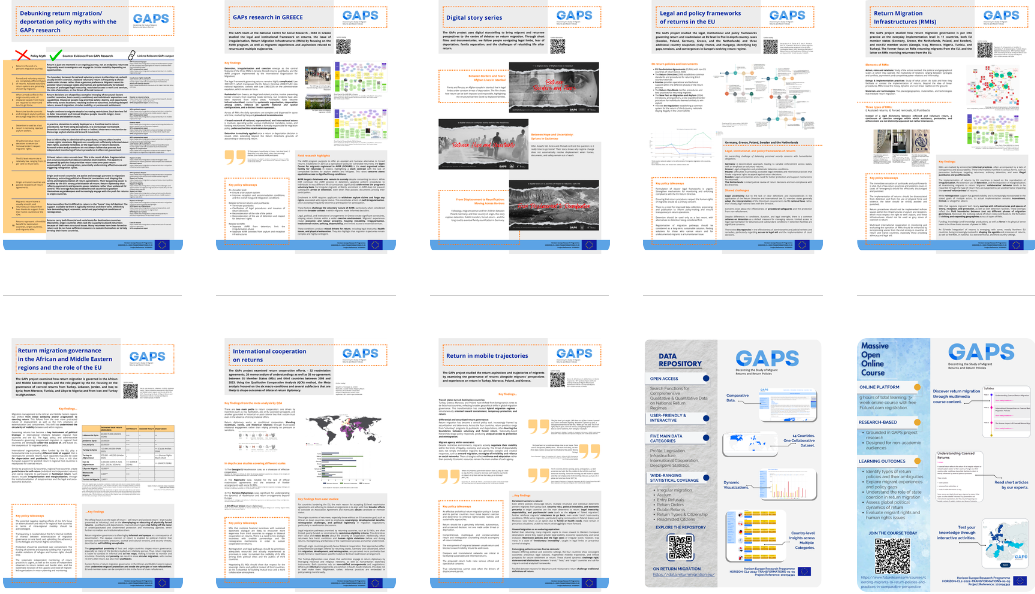
A selection of visual materials presenting key insights and findings from the GAPs project in a concise and research-focused way. Visual research outputs developed within the GAPs project present recent findings and key insights produced by researchers from partner institutions, translating complex analyses on migrant returns, readmission policies, & reintegration processes into focused visual formats.
GAPs Online Course
GAPs ONLINE COURSE
How States Coerce Migrants to Return: Comparative Perspectives
The GAPs MOOC is a free, three-week FutureLearn course that makes the project's core research accessible to a wide audience. The GAPs Online Course is a free, three-week programme on FutureLearn that makes the project’s core research accessible through expert videos, case studies, and interactive content, exploring return migration, governance, and migrants’ lived experiences.
Data repository
DATA REPOSITORY
Qualitative & quantitative data on national return regimes
The Data Repository collects all relevant quantitative, qualitative, and visual data into five main categories: Profile, Legislation, Infrastructure, International Cooperation, and Descriptive Statistics. GAPs Data Repository offers an overview of available qualitative and quantitative data on national return regimes. It is launched in 2024 as an output of the ‘GAPs: De-centring the Study of Migrant Returns and Readmission Policies in Europe and Beyond’ Project.


Network & media


GAPs Header Section BG.png