“Imprisonment and return: Greece in the landscape of European policies on migrant returns” GAPs Public Forum:
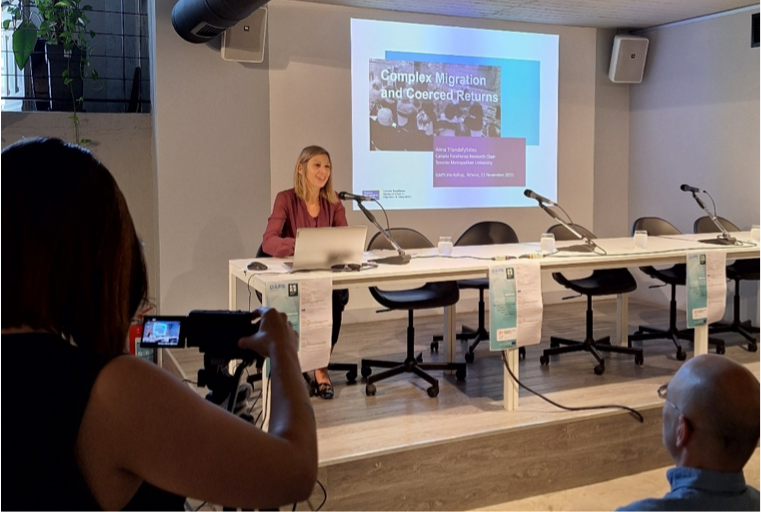
Opening presentation delivered by Eva Papatzani, a member of the GAPs Project EKKE team.
On November 21, 2025, a Public Forum entitled “Imprisonment and Return: Greece in the landscape of European policies on migrant returns” was organized in Athens to discuss the findings of the GAPs research project: De-centring the Study of Migrant Returns and Readmission Policies in Europe and Beyond.
The Forum opened with a keynote speech entitled “Complexity in Migration and Coerced Returns” by Professor Anna Triantafyllidou, Canada Excellence Research Chair in Migration and Integration, Toronto Metropolitan University. Recognizing critical differences in the characteristics and governance of migration between the 20th and 21st centuries that make time and space seem more compressed than ever, the speech proposed a new descriptive and analytical framework for understanding complexity in migration. Anna presented a set of descriptive dimensions of complexity (including motivations, legal categories, duration, spatial scale, physical vs digital), discussed the related implications for migration governance (multi-level and multi-scalar) and a set of analytical considerations (complexity as diversity/heterogeneity; self-reflexivity; networking/connectedness; conflict). The complexity approach was also used to make sense of coerced return migration in Greece and the broader Mediterranean region.
This was followed by a panel discussion entitled “Return migration infrastructures in Greece and internationally. Institutions, practices, and materials in the continuum of coercion” in which members of the EKKE project team presented the main findings of the research.
More specifically, the panel opened with a presentation by Eva Papatzani, who introduced the concept of return migration infrastructures and how it shaped the analytical lens of the project. Next, Panos Hatziprokopiou presented the synthesis findings of the study of return infrastructures in 11 countries and highlighted the complexity that characterizes the daily implementation of returns in practice, emphasizing the continuum of coercion, issues of irregularity, practices of exercising power, and informal practices. The continuum of coercion and the question of the voluntary nature of returns were also raised in the next presentation by Giorgos Kandylis, who presented the findings of the EKKE research on the Assisted Voluntary Return and Reintegration program (AVRR) implemented in Greece by the International Organization for Migration. Eva Papatzani then highlighted the importance of the issue of irregularity in the Greek context of migration and asylum as a whole, beyond the return system. Finally, Timokleia Psallidaki discussed coerced returns and the obstacles migrants face when settling in Greece, drawing on relevant field research on the experiences of migrants.
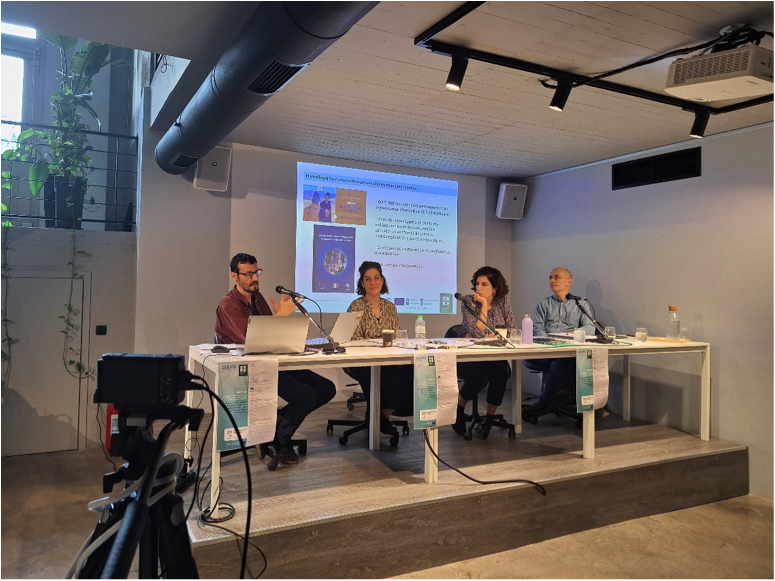
George Mavrommatis (Harokopio University) commenting on the presentations and key issues in contemporary migration studies.
George Mavrommatis, Assistant Professor, Harokopio University commented on all presentations, emphasizing the importance of the concept of infrastructure in the study of migration. In addition, he raised critical questions about the political moment that characterizes today’s Europe and the paradigm shift that is emerging in relevant policies. He also highlighted the importance of reflexivity in the study of migration, and especially in critical migration studies.
Following this, a round table discussion was held with the project’s Stakeholders Expert Panel, entitled “Return policies in Greece: Recent developments, critical approaches, alternative practices”. Participants included Ilias Tsampardoukas (Greek National Commission for Human Rights, Recording Mechanism of Informal Forced Returns), Angelina Sora (The Greek Ombudsman, External Monitoring of Forced Returns), Vasilis Papadopoulos (Greek Council for Refugees), Minos Mouzourakis (Refugee Support Aegean), Elli Kriona Saranti (HIAS Greece), Yonous Mouhammadi (Greek Forum of Refugees) and Kostas Amargiotakis (Open School for Migrants in Piraeus), under the coordination of Dimitris Angelidis, Journalist at Efimerida ton Syntakton.
The participants shared their views on recent developments regarding the suspension of asylum applications and the criminalization of irregular stay, and how these relate to the country’s return policy. In addition, they expressed their organizations’ views on desirable practices for the future, including proposals for different policies, as well as civil society actions to monitor or contest existing policies.
Overall, the Public Forum provided a fertile ground for dialogue on the issues of migrant returns in Greece and, in particular, return migration infrastructures. The dialogue between research, policy, and everyday reality is crucial for a comprehensive understanding of the various aspects of coerced return migration, especially in the current context of the apparent tightening of relevant policies.