
PRESS RELEASE: MEPs Warn Return Policies Must Be Developed with Scientific Community, Not Driven by Politics
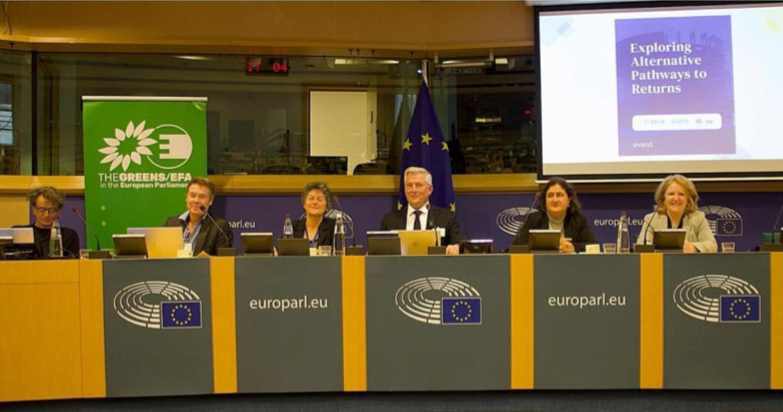
Pictured from left to right: Soner Barthoma, Arjen Leerkes, Tineke Strik, Terry Martin, Zeynep Sahin-Mencütek, Michele Levoy. Photo credit PICUM, European Parliament, 19 November 2025
MEPs warn that citing research is not enough. Migration policies should be grounded in real evidence.
On November 19, 2025 at the European Parliament, a stark warning was issued that the New Common European System for Returns (the “proposal”) is being shaped by political rhetoric rather than robust scientific evidence, risking the criminalisation of irregular migrants and the stripping of existing human rights protections.
Despite explicitly citing the Horizon Europe research projects FAiR, GAPS, MORE, and MirreM, the proposal lacks a clear problem analysis and fails to integrate scientific evidence, stated Members of the European Parliament.
MEP Tineke Strik pointed out that the Staff Working Document should have shown evidence behind the draft Returns Regulation, drawing on Horizon-funded research. Negotiations in the Council and Parliament are already moving ahead, yet this analysis is still missing, which raises real concerns about how policymakers are supposed to assess the proposal.
“We lack the evidence and the explanation for why the Commission believes this proposal will solve any problems. This is dangerous,” said MEP Tineke Strik, underscoring the urgency for evidence-based policy. She warned that while voluntary return remains formally prioritised, the proposed system risks disincentivising voluntary return and facilitating coercion at the earliest stages of the return procedure. The proposal, she cautioned, risks "de-harmonizing" return policy and rests on the flawed assumption that returnees bear primary responsibility, while neglecting systemic shortcomings in member states' procedures and data.
Risks of Vague Proposals and Weakened Safeguards
MEP Murielle Laurent raised grave concerns about the proposal's direction. “We fear the proposal risks moving toward the criminalisation of irregular migrants,” she said, urging stronger safeguards, especially for children. “We must be extremely careful… the conditions of detention in some places are very poor.”
Call for Evidence to Counter Political Rhetoric
MEP Fabienne Keller explicitly detailed the alignment between the research and political realities: “The research from GAPs states that effective and sustainable returns are voluntary returns and the research from FAiR argues the need to legislate at European level because non-return is a structural and long-term reality we have to face. The MORE project is very interesting on the issue of detention.”
Keller concluded that the research is “highly relevant and comes at the right time,” but noted that a growingfar-rightinfluenceiscomplicating negotiations.
Concrete, Evidence-Based Recommendations
With the proposal currently making its way through the European Parliament, researchers highlighted the following evidence-based recommendations as a path forward:
GAPs recommends:
Prioritise mutually beneficial cooperation models for returns supported by meaningful reintegration and legal mobility pathways.
Strengthen effective, rights-based return governance by prioritising voluntary return, procedural safeguards, and robust monitoring.
FAiR recommends:
Involve third countries and non-state actors in the design and implementation of return and non-return policies.
Establish an independent human rights monitoring system to oversee enforced return and non-return practices.
MORE recommends:
Eliminate migration detention and expand community-based case management to uphold rights and reduce harm.
Prioritise stable residence permits on various grounds, including for those who cannot be returned.
Click here to display and download the PRESS RELEASE PDF document
Finding Agreement in Return (FAiR)
Prof. Arjen Leerkes, Principal investigator, Erasmus University Rotterdam
De-centring the Study of Migrant Returns and Readmission Policies in Europe and Beyond (GAPS) Principal investigators: Dr. Zeynep
Sahin-Mencütek, Bonn International Centre for Conflict Studies, and Soner Barthoma, Uppsala University
gaps.return.migration@gmail.com https://www.returnmigration.eu/
Motivations, Experiences and Consequences of Returns and Readmissions Policy: Revealing and Developing Effective Alternatives (MORE)
Dr. Olga Jubany, Principal investigator, Universitat de Barcelona

Contact: gaps.return.migration@gmail.com